11.29.2006

Zelda

Nintendo has put together a six-part video chronicling the history of Zelda. I don't think I've played the game since the original Nintendo, but watching the video brought back a lot of good memories. Makes me wish I'd kept my Nintendo so I could play again for old times sake. Have a look if you're feeling nostalgic. I've embedded Part 1 below.

11.27.2006

NSTA Bought By Big Oil?

I learned today that the National Science Teachers Association, of whom I'm a member, recently turned down 50,000 free copies of Al Gore's An Inconvenient Truth. Their reason was simple: they didn't want to risk the millions of dollars they get from Exxon-Mobil or the American Petroleum Institute. Doesn't exactly make me proud to be a member. I wrote them a letter today and if you would like to send them a comment, go here.

11.21.2006

My Magnet Is Bigger Than Yours


Sweet photo. This superconducting magnet is being used by the Large Hadron Collider, which is set to start operating next year.

11.20.2006

Future Science

Curious as to where science will go in the next 50 years? The magazine New Scientists asked 70 of the world's leading scientists what they thought. You can find their answers here.

(Via Cosmic Variance)

11.19.2006

Neandertal

There's been a lot of stories about the Neadertal genome lately, due to a couple of papers in Science and Nature. If you'd like a clearer understanding of what is being reported. check out John Hawk's FAQ. You can't get a much better explanation.

11.12.2006

Sea Urchins

The genome of a sea urchin (Strongylocentrotus purpuratus) was published this week in the journal Science. While the papers themselves are subscription only, there is a really cool interactive poster that explains the significance of these studies, including video of the researchers and their explanations. Check it out here.

11.01.2006

What Do You Know?

US News & World Report has a quiz to see if you retained anything from your education. Once you've finished taking it, you can find the answers here.

10.29.2006

Reality in Iraq

Brad DeLong points to an excellent article in Newsweek concerning present conditions in Iraq and the numerous problems and obstacles the U.S faces in achieving anything over there. Many will probably complain that the media is again focusing on the negative while ignoring the positive. Perhaps. But ignoring the serious problems will not make them go away. A taste:

From the beginning of the war, the Bush administration has not wanted to think of Iraq in these sectarian terms, preferring instead to believe the country was the place it hoped it would be—united, secular, harmonious, freedom-loving. As a result, Washington massively underestimated the challenge it faced. By unseating Saddam Hussein and introducing democracy, the United States introduced Shia-majority rule to Iraq. It also disbanded the Army, with its largely Sunni officer corps, fired 50,000 mostly Sunni bureaucrats and shut down dozens of state-owned factories (many run by Sunnis). In effect, the United States destroyed both the old Iraqi nation and the old Iraqi state. And yet it had no plan, people or resources to fill the void left behind.

Call for Change

Call for Change is a chance for you to help reach out to voters about this year's election. You can do it from your home phone or computer and it is relatively straight forward. A little bit can go a long way.


Call For Change

10.25.2006

Coral Catastrophe

From CNN:

Researchers fear more than half the world's coral reefs could die in less than 25 years and say global warming may at least partly to blame.

Sea temperatures are rising, weakening the reefs' resistance to increased pollutants, such as runoff from construction sites and toxins from boat paints. The fragile reefs are hosts to countless marine plants and animals.

"Think of it as a high school chemistry class," said Billy Causey, the Caribbean and Gulf Mexico director of the National Oceanic and Atmospheric Administration.

"You mix some chemicals together and nothing happens. You crank up the Bunsen burner and all of a sudden things start bubbling around. That's what's happening. That global Bunsen burner is cranking up."

Causey was one of some 200 private and government researchers from the Caribbean, Florida and U.S. Pacific islands who gathered in St. Thomas for a meeting of the NOAA's U.S. Coral Reef Task Force.

Last year's coral loss in the Caribbean waters supports predictions that 60 percent of the world's coral could die within a quarter century, said Tyler Smith of the University of the Virgin Islands.

"Given current rates of degradation of reef habitats, this is a plausible prediction," Smith said.

More than 47 percent of the coral in underwater study sites covering 31 acres around the U.S. Virgin Islands died after sea temperatures exceeded the norm for three months in 2005, said Jeff Miller, a scientist with the Virgin Islands National Park.

The unusual warm water can stress coral, causing it to lose its pigment and making it more vulnerable to disease.

This year, Caribbean coral narrowly avoided another widespread episode of bleaching when sea temperatures briefly surpassed levels considered healthy for reefs.

Up to 30 percent of the world's coral reefs have died in the last 50 years, and another 30 percent are severely damaged, said Smith, who studies coral health in the U.S. Virgin Islands and collaborates with researchers globally.

"U.S. Virgin Islands coral today is likely at its lowest levels in recorded history," Smith said.

The researchers said global warming was a potential cause of the abnormally high sea temperatures but was not the only suspect in the reefs' demise.

What causes disease in coral can be hard to pinpoint and could be a combination of things. Other threats include silt runoff from construction sites, which prevents the coral from getting enough sunlight, and a record increase in fleshy, green algae, which competes with coral for sunlight.

"Climate change is an important factor that is influencing coral reefs worldwide," said Mark Eakin, director of NOAA's Coral Reef Watch. "It adds to the other problems that we are having."

10.23.2006

Poker

I won my first poker tournament over the weekend. Twelve players (a group of friends) with a five dollar buy-in. Nothing spectacular, although it was a lot of fun. My wife got second, which was cool. If you want to read a good account of some really high stakes poker, go here. Andy Beal and Phil Ivey had quite a showdown a few months ago.

10.20.2006

Miscommunication

Ed Brayton points to a Yahoo News article where General Peter Pace says that Rumsfeld receives his insights from God himself. Considering Rumsfeld's crappy track record on pretty much everything he has done, I'd say the message is getting garbled somewhere. It also makes me much less confident in Peter Pace.

10.19.2006

Don't Start Worrying...Yet

This is bound to stir up some controversy. A professor at the University of Washington, Eric Cheney, claims the idea that we are running out of oil is one of the seven myths concerning resource geology. Why?

Changing economics, technological advances and efforts such as recycling and substitution make the world's mineral resources virtually infinite, said Cheney, a UW professor emeritus of Earth and space sciences. For instance, oil deposits unreachable 40 years ago can be tapped today using improved technology, and oil once too costly to extract from tar sands, organic matter or coal is now worth manufacturing.
The article goes on to explain some of his other thoughts on the matter. Included are the other six myths:

  • Only basic extraction and processing costs affect economic geology. That fails to account for such costs as exploration, transportation, taxes and societal and environmental programs.
  • Production always damages the environment. Accidents do happen, Cheney said, but much of the perception is based on problems of the past and don't reflect current reality. "It's inevitable that there are going to be oil spills, just like tere are traffic accidents on the freeway," he said. "We hope we can manage them, but nothing is risk free."
  • Mineral deposits are excessively profitable. Despite widely reported huge oil company profits in the last year, Cheney notes that as a percentage of company revenues oil profits lag far behind those of some major software and banking companies.
  • Transportation costs are trivial. In fact, the retail cost of building materials such as sand and gravel are largely driven by the cost of moving them from one place to another, particularly in crowded urban areas. Moving quarries and pits farther away from where people live only increases those costs.
  • Ore deposits are uniform. While a valued ore can be found in a large continuous deposit, often it is mixed with other kinds of minerals and extraction becomes more expensive.
  • Resources are randomly distributed and so, if human population encroaches, a mine or quarry should simply be able to relocate.

10.18.2006

A Round of Evolution for Everyone

One of my favorite science writers, Carl Zimmer, has a couple of great new articles available. One, found on his blog, explores what mycologists are starting to discover about the evolutionary history of fungi. Fungi have to be some of the weirdest organisms on the planet and its been very difficult to tease out their origins and subsequent evolution. Scientists are making headway though.

Carl's second article can be found in this month's National Geographic. It provides and up-to-date overview of the evolution of complexity found in living organisms. On his blog, Carl provides some links to published papers to give interested readers more background. All around, fascinating stuff.

Update: ScienceDaily has an article on the fungi paper in Nature. Good for the lay person.

10.12.2006

Face the Truth


(HT to Razib)

10.09.2006

Spying on Mars

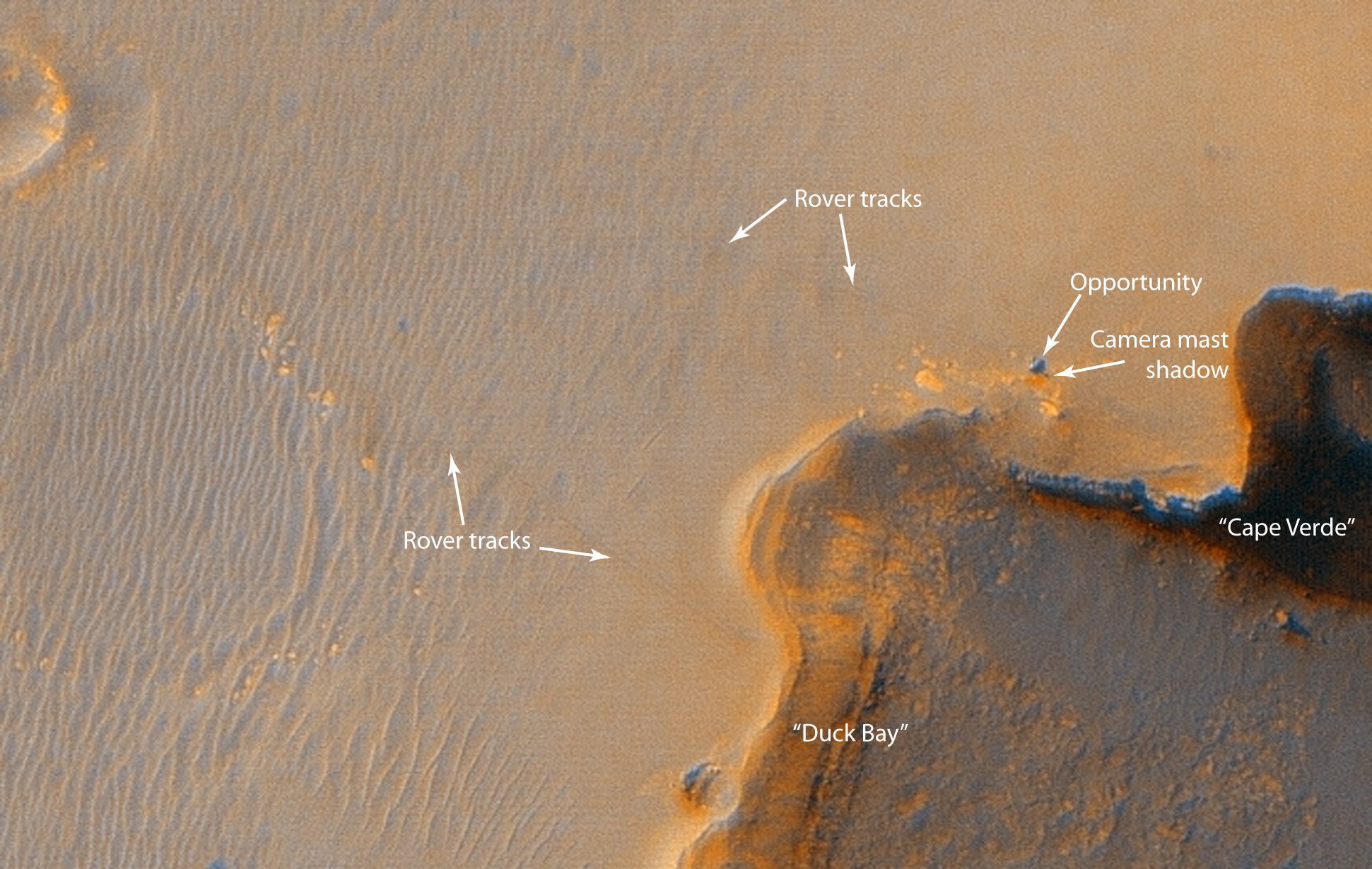
Click on the picture to get a bigger view. What you're looking at is a snapshot from the Mars Reconnaissance Orbiter of the rover Opportunity at Victoria Crater. The Mars Rovers only had a 90 day mission life; they are nearing day 1,000. It's pretty cool to see two very successful space missions interact like this.

10.08.2006

TerraPass


If you're like me and wished you owned a hybrid vehicle and wondered what you can do to offset the CO2 emitted from you're standard vehicle, well, you now have an answer: TerraPass. This organization gives you a chance to offset your carbon emissions due to driving or flying. A yearly pass costs anywhere from $9.95/year (41+ mpg and up) to $79.95/year (for cars getting between 10-18 mpg). The money you spend is then used to fund clean energy projects such as wind energy, biomass products, and projects related to industrial efficiency. All funds are verified by a third party, the Center for Resource Solutions. As cars are responsible for 25% of CO2 pollution worldwide, this program could have a real impact.

In addition to your cars, you can also purchase a TerraPass for any flights you may be taking. Again, the cost of the pass depends on how many miles you are planning to fly. The low end is $9.95 for flights under 6,000 miles while frequent fliers can pay up to $1,499 (1,000,000 or so miles). Higher payments have some nice little gifts associated with them (not to mention the feeling of doing something positive!).

Inner Life Explained

A few weeks ago I posted a video that takes an inner view of the cell. Now, thanks to Wayne of the blog Niches, we have a shot by shot explanation of what we are actually seeing. The animation is much more fascinating with a little knowledge.

Liberal Top Ten

Geoff Stone of UC Law Blog has drafted ten propositions that he feels define a liberal. He invites a debate, so go read and think about them here.

10.04.2006

Traveling & Learning

One of the advantages of working in a private school is options for professional development. Many public schools simply don't have the money to send their teachers to major conferences or workshops. My Head of School really advocates teachers getting out there and learning new ideas and methods and thus always has a healthy budget for development. So far I'm scheduled to take a NOAA/Seattle Aquarium workshop on ocean science; a workshop for specific science topics and methodologies for grades k-5; a math workshop to improve problem solving skills; and the National Science Teachers Association's regional conference in Salt Lake City. I'm actually amazed he said yes to all four. Just goes to show you that it doesn't hurt to ask. So, the next three months should provide me with some exciting opportunities to learn new ideas and have discussions with my peers. It will also help recharge the old battery before going into the long winter haul.